


Canada Express Entry
Complete Guide to Obtaining Permanent Residence Through Canada’s Points-Based System
What is Express Entry?
Express Entry is the Canadian government’s online selection system used to manage permanent residence applications for skilled workers. Rather than operating on a first-come, first-served basis, it ranks candidates against each other using a structured points system.
The system currently manages three major federal economic immigration programs:
Individuals who meet the eligibility requirements of at least one of these programs can create an online profile. Once submitted, eligible candidates enter a pool where they are assigned a score under the Comprehensive Ranking System (CRS).
The CRS evaluates core factors that research has shown to influence economic success in Canada, including age, education level, official language proficiency, skilled work experience, and additional elements such as provincial nominations.
Immigration, Refugees and Citizenship Canada (IRCC) regularly conducts selection rounds and invites the highest-ranking candidates to apply for permanent residence. Those who receive an Invitation to Apply (ITA) can then submit a complete permanent residence application for final assessment.
Because of its transparent ranking structure and structured selection process, Express Entry remains one of the primary pathways for skilled professionals seeking permanent residence in Canada.
Programs Under the Express Entry System
To enter the Express Entry pool, you must first meet the minimum requirements of one of these 3 federal programs.
Federal Skilled Worker Program (FSWP)
skilled work experience in TEER 0, 1, 2, or 3
at least 1 year of continuous paid work (or 1,560 hours total), gained within the last 10 years (in Canada or abroad)
you must show you performed the lead statement and most main duties of your selected NOC
language: approved test results meeting at least CLB 7 in all 4 abilities (reading, writing, listening, speaking)
you must score at least 67/100 on the FSW selection factors grid (this is separate from CRS)
Canadian Experience Class (CEC)
- Canadian skilled work experience in TEER 0, 1, 2, or 3
- at least 1 year of paid Canadian work (1,560 hours), gained in the 3 years before you apply
- experience must be obtained while authorized to work in Canada (and if remote, you must have been physically in Canada working for a Canadian employer)
- self-employment and work gained while you were a full-time student does not count toward the minimum requirements
- language (by TEER):
TEER 0 or 1: minimum CLB 7 in all 4 abilities
TEER 2 or 3: minimum CLB 5 in all 4 abilities
Federal Skilled Trades Program (FSTP)
at least 2 years of full-time paid skilled trades work (or 3,120 hours total) in the 5 years before you apply
your trade must fall within the eligible NOC groups listed by IRCC, and you must meet the job requirements for that trade in the NOC
you must have been qualified to practise the trade where you gained the work experience
you must have either:
a valid full-time job offer for at least 1 year (can be from up to 2 employers), or
a certificate of qualification issued by a Canadian provincial/territorial (or federal) authority
language: minimum CLB 5 (speaking/listening) and CLB 4 (reading/writing)
there is no education requirement for eligibility (though education can help your CRS ranking)
Provincial Nominee Program (PNP)
you must be eligible for Express Entry (one of the 3 programs above)
you apply to a province/territory’s enhanced PNP stream (or accept a nomination if you’re invited)
once the nomination is added/accepted in your Express Entry profile, you receive 600 additional CRS points
this typically puts you in a strong position to receive an ITA in a subsequent round, but IRCC still makes the final PR decision
1. Federal Skilled Worker (FSW) Program
At least 1 year of skilled work experience (TEER 0, 1, 2, or 3)
Minimum CLB 7 in English or French
Minimum score of 67 out of 100 on the FSW selection grid
2. Canadian Experience Class (CEC)
At least 1 year of full-time Canadian skilled work experience
Language proficiency suitable for the job level (e.g., CLB 7 for NOC 0/A, CLB 5 for NOC B)
3. Federal Skilled Trades (FST) Program
At least 2 years of full-time experience in a skilled trade within the last 5 years
Either:
A valid Canadian job offer OR
A Certificate of Qualification from a Canadian province/territory
Minimum CLB 5 for speaking and listening, CLB 4 for reading and writing
4. Provincial Nominee Program (PNP) via Express Entry
If a province nominates you under an enhanced PNP stream, you:
Must first qualify for one of the three federal programs above
Receive 600 additional CRS points
Are virtually guaranteed an ITA
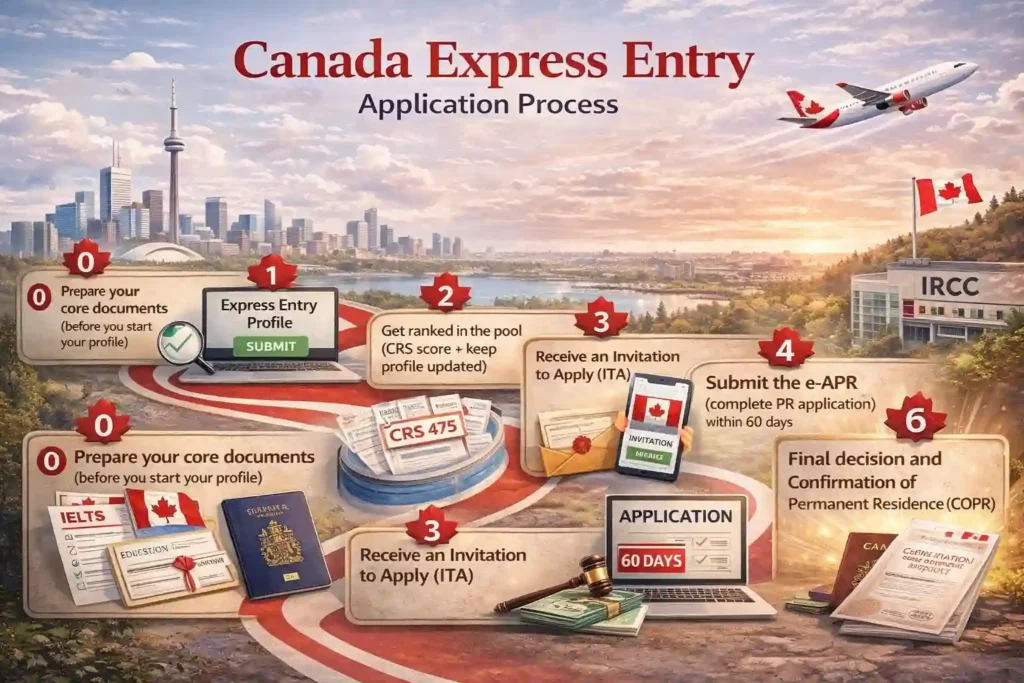
How Express Entry Works: Step-by-Step
Step 0: Prepare your core documents (before you start your profile)
Before creating a profile, most applicants should have:
- Language test results (valid and ready to enter in the system)
- ECA (if your education was completed outside Canada)
- Passport / travel document details
- Work history details (NOC/TEER classification, dates, duties, etc.)
Step 1: Create and submit your Express Entry profile (online)
- Sign in to an IRCC secure account and start the Express Entry profile.
- Enter your details (age, education, language scores, work history, etc.).
- Important timing rule: you have 60 days to complete and submit your Express Entry profile once you start it, otherwise you must begin again.
- If eligible, IRCC places you in the Express Entry pool and ranks you.
Step 2: Get ranked in the pool (CRS score + keep profile updated)
- After submission, you receive a CRS score and a ranking in the pool.
- You must keep your profile up to date if anything changes (new test results, marital status, job changes, etc.).
- If you’re not invited within 12 months, your profile expires automatically and you must create a new one.
Step 3: Receive an Invitation to Apply (ITA)
IRCC issues ITAs through rounds of invitations (general, program-specific, and category-based selections).
If you receive an ITA, it will specify which program you’re invited under.
Your ITA is valid for 60 days only.
Step 4: Submit the e-APR (complete PR application) within 60 days
After ITA, you submit your electronic Application for Permanent Residence (e-APR). IRCC breaks it into four actions:
Fill out the application form
Upload supporting documents
Pay the fees
Submit the application
Step 5: IRCC processing (eligibility + background + medical + biometrics)
After you submit:
- IRCC reviews eligibility and verifies documents
- Background checks include criminality/security screening (as applicable)
- You may be asked to complete biometrics (if required)
- You must complete an immigration medical exam (as required in your instructions)
Step 6: Final decision and Confirmation of Permanent Residence (COPR)
If approved:
- IRCC issues a Confirmation of Permanent Residence (COPR)
- Depending on where you are, IRCC provides instructions to finalize PR status (for example, online confirmation for in-Canada applicants or travel document instructions for overseas applicants).
Processing Time: Approximately 6 months after submission of a complete application (IRCC service standard)
Application Cost:
| Applicant Type | Application Fee | Permanent Residence Fee | Biometrics |
|---|---|---|---|
| Main applicant | $950 CAD | $575 CAD | $85 CAD |
| Spouse | $950 CAD | $575 CAD | $85 CAD |
| Child | $260 CAD | Not required | Not required |
| Family biometrics total: $170 CAD |
Comprehensive Ranking System (CRS) Points Breakdown
The CRS is a points-based system used to assess and rank Express Entry candidates. The maximum total score is 1,200 points.
| Points Factor | Maximum Points for Single Applicants | Maximum Points for Married Applicants |
|---|---|---|
|
Human and Skill Factors (Age, Language, Education, and Work Experience)
|
500 |
460 |
|
Human and Skill Factors of Spouse of Applicant |
– |
40 |
|
Transferability Factors
|
100 |
100 |
|
Other Factors like Provincial Nomination
|
600 |
600 |
|
Total Points |
1,200 |
1,200 |
The Comprehensive Ranking System (CRS) determines how candidates are ranked in the Express Entry pool. Points are awarded for age, education, language ability, work experience, and additional factors such as provincial nomination. Understanding how these elements are calculated is essential for evaluating overall competitiveness.
Or calculate an estimated CRS score instantly using the online assessment form.
Age Points
| Age | Principal Applicant Married Maximum Points: 110 | Principal Applicant Single Maximum Points: 110 |
|---|---|---|
| 17 or less | 0 | 0 |
| 18 | 90 | 99 |
| 19 | 95 | 105 |
| 20-29 | 100 | 110 |
| 30 | 95 | 105 |
| 31 | 90 | 99 |
| 32 | 85 | 94 |
| 33 | 80 | 88 |
| 34 | 75 | 83 |
| 35 | 70 | 77 |
| 36 | 65 | 72 |
| 37 | 60 | 66 |
| 38 | 55 | 61 |
| 39 | 50 | 55 |
| 40 | 45 | 50 |
| 41 | 35 | 39 |
| 42 | 25 | 28 |
| 43 | 15 | 17 |
| 44 | 5 | 6 |
| 45 or more | 0 | 0 |
Education Points
| Education Level | Married Applicant Maximum 140 points for the primary applicant and 10 points for the spouse | Single Applicant Maximum points: 150 |
|---|---|---|
| High School Diploma | Primary applicant: 28 points and Spouse: 2 points | 30 |
| One-Year Program After High School | Primary applicant: 84 points and Spouse: 6 points | 90 |
| Two-Year Program After High School | Primary applicant: 91 points and Spouse: 7 points | 98 |
| Bachelor's Degree or a Three-Year Program or More After High School | Primary applicant: 112 points and Spouse: 8 points | 120 |
| Two or More Educational Qualifications After High School at least one of which must be from a program that is at least three years long | Primary applicant: 119 points and Spouse: 9 points | 128 |
| Master’s Degree or Specialized Internship Program | Primary applicant: 126 points and Spouse: 10 points | 135 |
| Doctorate | Primary applicant: 140 points and Spouse: 10 points | 150 |
- For education completed outside Canada, an Educational Credential Assessment (ECA) is required in order to claim CRS points.
- Only completed credentials are eligible for CRS points.
Language Proficiency
First Foreign Language Skill (English or French)
| CLB Level | Married Applicant:Maximum 128 points for the primary applicant and 20 points for the spouse | Single Applicant:Maximum points: 136 |
|---|---|---|
| CLB 4 | For each skill: Primary applicant: 6 points and Spouse: 0 points | 6 |
| CLB 5 | For each skill:Primary applicant: 6 points and Spouse: 1 point | 6 |
| CLB 6 | For each skill:Primary applicant: 8 points and Spouse: 1 point | 9 |
| CLB 7 | For each skill:Primary applicant: 16 points and Spouse: 3 points | 17 |
| CLB 8 | For each skill:Primary applicant: 22 points and Spouse: 3 points | 23 |
| CLB 9 | For each skill:Primary applicant: 29 points and Spouse: 5 points | 31 |
| CLB 10 and above | For each skill:Primary applicant: 32 points and Spouse: 5 points | 34 |
Second Foreign Language Skill (English or French)
| CLB Level | Married Applicant Maximum Points: 22 | Single Applicant Maximum Points: 24 |
|---|---|---|
| CLB 5 or 6 | 1 point for each skill | 1 point for each skill |
| CLB 7 or 8 | 3 points for each skill | 3 points for each skill |
| CLB 9 or higher | 6 points for each skill | 6 points for each skill |
Second official language points apply only to the principal applicant.
Additional French-Language Bonus Points
Candidates with strong French ability may receive extra CRS points under the Additional Factors category:
Up to 25 additional points for high French proficiency
Up to 50 additional points for high French proficiency combined with strong English ability
These bonus points are separate from the core language score.
Accepted Language Tests for Express Entry
Only the following tests are accepted:
English:
IELTS General Training
CELPIP General
PTE Core
(Note: IELTS Academic, CELPIP General-LS, TOEFL, and Duolingo are not accepted.)
French:
TEF Canada
TCF Canada
Each test has its own scoring system. Results must be converted to Canadian Language Benchmark (CLB) levels to calculate CRS points accurately.
Example Calculation
If a married principal applicant scores CLB 7 in all four abilities, they receive:
16 × 4 = 64 points
If their spouse scores CLB 9 in all four abilities, they receive:
5 × 4 = 20 points
Total language points for the application = 84 points
Canadian Work Experience
| Canadian work experience | Married applicant:A maximum of 70 points for the main applicant and 10 points for the spouse | Single applicant:Maximum points: 80 |
|---|---|---|
| Less than a year | 0 | 0 |
| 1 year | Main applicant: 35 points and Spouse: 5 points | 40 |
| 2 years | Main applicant: 46 points and Spouse: 7 points | 53 |
| 3 years | Main applicant: 56 points and Spouse: 8 points | 64 |
| 4 years | Main applicant: 63 points and Spouse: 9 points | 72 |
| 5 years or more | Main applicant: 70 points and Spouse: 10 points | 80 |
What Counts as Canadian Work Experience?
To be eligible for CRS points, Canadian work experience must meet the following conditions:
The work must be in a skilled occupation classified under TEER 0, 1, 2, or 3 of the National Occupational Classification (NOC).
The experience must have been gained while legally authorized to work in Canada.
It can be full-time (at least 30 hours per week) or an equivalent amount of part-time work.
The work must be paid employment (volunteer work does not qualify).
Work Experience While Studying
It is important to distinguish between eligibility requirements and CRS scoring:
Work experience obtained while studying full-time in Canada does not count toward eligibility under the Canadian Experience Class (CEC).
However, such experience may still count toward CRS points, provided it was legally authorized and meets all other requirements.
Canadian work experience can significantly improve your overall CRS score, especially when combined with strong language results and education credentials.
Skill Transferability Factors (Maximum 100 Points)
The Skill Transferability section of the Comprehensive Ranking System (CRS) rewards candidates who combine strong human capital factors, such as education, language ability, and work experience.
Under this category:
A maximum of 100 points can be awarded.
Each combination can grant up to 50 points.
Even if a candidate qualifies for more than 100 points across combinations, the total awarded will not exceed 100.
No points are awarded to the spouse under Skill Transferability.
Points are only granted if the minimum required thresholds (such as CLB levels or skilled work experience) are met in all four language abilities.
Education + Language Proficiency
Candidates can receive additional points if they combine post-secondary education with strong official language results.
Language requirement:
CLB 7 or higher in all four abilities (Reading, Writing, Listening, Speaking)
Higher points are awarded at CLB 9 or above in all four abilities
| Qualification | CLB 7 or CLB 8 in all language skills | CLB 9 or higher in all language skills |
|---|---|---|
| One-year or more post-diploma course | 13 | 25 |
| Two post-diploma qualifications one of which is for a program of at least three years | 25 | 50 |
| Master's degree or professional internship | 25 | 50 |
| Doctorate | 25 | 50 |
Note: If education was completed outside Canada, a valid Educational Credential Assessment (ECA) is required to claim points.
Education + Canadian Work Experience
Candidates who combine post-secondary education with Canadian skilled work experience may receive additional points.
Requirements:
Canadian work experience must be in a TEER 0, 1, 2, or 3 occupation
Work must have been legally authorized
| Qualification | 1 year of Canadian work experience | 2 years of Canadian work experience or more |
|---|---|---|
| One-year or more post-diploma course | 13 | 25 |
| Two post-diploma qualifications one of which is for a program of at least three years | 25 | 50 |
| Master's degree or professional internship | 25 | 50 |
| Doctorate | 25 | 50 |
Foreign Work Experience + Language Proficiency
Foreign skilled work experience combined with strong language ability can increase CRS points.
Requirements:
Foreign work experience must be in a skilled occupation (TEER 0–3)
Language threshold must be met in all four abilities
| Work experience | CLB 7 and above in all language skills | CLB 9 and above in all language skills |
|---|---|---|
| 1 or 2 years of foreign work experience | 13 | 25 |
| 3 years or more of foreign work experience | 25 | 50 |
Example: Mahsa has 3 years of experience as an administrative expert in a trading company in Iran. She has achieved a general IELTS score of 6.5 in all skills and 7.5 in Listening. This adds 25 points to her application.
Foreign Work Experience + Canadian Work Experience
Candidates with both foreign and Canadian skilled work experience may receive additional points.
Requirements:
Both foreign and Canadian experience must be in TEER 0–3 occupations
Canadian work must have been legally authorized
| 1 year of Canadian work experience | 2 years of Canadian work experience or more | |
|---|---|---|
| 1 or 2 years of foreign work experience | 13 | 25 |
| 3 years or more of foreign work experience | 25 | 50 |
Certificate of Qualification (Skilled Trades) + Language
Candidates with a valid Canadian certificate of qualification in a skilled trade may receive additional points when combined with language proficiency.
Requirements:
Certificate must be issued by a Canadian provincial, territorial, or federal authority
Language scores must meet the minimum threshold in all four abilities
| Vocational certificate | CLB 5 and above in all language skills | CLB 7 and above in all language skills |
|---|---|---|
| Vocational certificate | 25 | 50 |
Important Notes
Points are only awarded if the required minimum language levels are met in all four abilities.
Work experience (Canadian or foreign) must be paid and skilled (TEER 0–3).
The maximum total for all Skill Transferability combinations is 100 points, regardless of how many combinations a candidate qualifies for.
Spouses do not receive points under this section.
Additional CRS Points (Maximum 600 Points)
| Additional Factor | Points |
|---|---|
| Provincial Nomination | 600 |
| Sibling who is a Canadian citizen or permanent resident living in Canada | 15 |
| French language proficiency (CLB 7+ in all abilities) + English CLB 4 or none | 25 |
| French (CLB 7+) + English (CLB 5+ in all abilities) | 50 |
| One or two years of post-secondary education in Canada | 15 |
| Three or more years of post-secondary education in Canada | 30 |
Important Conditions for Additional CRS Points
Provincial Nomination (600 points)
Must be issued under an Express Entry–aligned (enhanced) provincial stream.
The nomination must be accepted in your Express Entry profile.
A provincial nomination alone grants the full 600 additional CRS points.
Sibling in Canada (15 points)
The sibling must be 18 years or older.
Must be a Canadian citizen or permanent resident.
Must be physically residing in Canada.
Eligible relationships include biological, half, step, or adopted siblings of the applicant or spouse.
French-Language Bonus (25 or 50 points)
French results must show CLB 7 or higher in all four abilities.
To receive 50 points, English must be CLB 5 or higher in all four abilities.
To receive 25 points, English must be CLB 4 or lower (or no English test provided).
Canadian Education Bonus (15 or 30 points)
To qualify:
The program must have been completed at an eligible Designated Learning Institution (DLI).
The program must have been at least 8 months in duration.
The applicant must have physically studied in Canada.
The credential must be fully completed.
Maximum Limit Rule
The total number of Additional CRS points cannot exceed 600 points, even if multiple factors apply.
Important Update (March 25, 2025)
Valid job offers no longer provide CRS points under Express Entry
Required Documents for Express Entry
Applying through Express Entry requires careful document preparation. Once an Invitation to Apply (ITA) is issued, candidates must submit a complete and accurate set of supporting documents within the given deadline.
These documents typically include proof of settlement funds, language test results, identification records, educational credential assessments, police clearance certificates, medical examination reports, and detailed employment references. Each document must meet IRCC’s official format requirements. Incomplete, incorrect, or improperly prepared documentation is one of the most common reasons for delays or refusals.
Because documentation requirements vary depending on the immigration program, family composition, and country of residence, understanding what is required — and how to prepare it correctly — is critical to a successful application.
For a complete breakdown of all required documents, detailed explanations, and official requirements, visit the full Express Entry Document Checklist guide.
Express Entry Financial Proof
Proof of funds requirements vary based on the total size of your family, including both accompanying and non-accompanying members. If you are invited to apply under the Federal Skilled Worker Program or Federal Skilled Trades Program, you must provide official written proof that you meet the minimum settlement fund requirement.
Funds must be available both at the time you submit your application and when IRCC issues your permanent resident visa.
You must obtain an official letter from your financial institution. The letter must be printed on official letterhead and include:
your name
bank contact information
all account numbers
the date each account was opened
current account balances
average balance over the past 6 months
details of any outstanding debts (such as loans or credit cards)
You must have legal access to the funds. Borrowed money cannot be used as proof of settlement funds, and property equity is not accepted. If applying with a spouse, funds held in a joint account may be counted. Funds held in your spouse’s individual account may also be used if you can demonstrate legal access.
| Number of Family Members | Financial Proof Amount (CAD) 2026 |
|---|---|
| 1 | $15,263 |
| 2 | $19,001 |
| 3 | $23,360 |
| 4 | $28,362 |
| 5 | $32,168 |
| 6 | $$36,280 |
| 7 | $40,392 |
| For each additional person | $4,112 |
Language Test
An approved language test is mandatory for the principal applicant. A spouse may also submit a language test to earn additional CRS points.
IRCC accepts the following language tests:
English
CELPIP General
IELTS General Training (IELTS Academic and IELTS One Skill Retake are not accepted)
PTE Core
French
TEF Canada
TCF Canada
Language results must be less than two years old at the time you submit your application.
Minimum language levels depend on the immigration program:
Federal Skilled Worker (FSW): Minimum CLB 7 (or NCLC 7) in all four abilities
Canadian Experience Class (CEC):
TEER 0 or 1: CLB/NCLC 7
TEER 2 or 3: CLB/NCLC 5
Federal Skilled Trades (FST):
Speaking & Listening: CLB/NCLC 5
Reading & Writing: CLB/NCLC 4
Language proficiency is converted to Canadian Language Benchmarks (CLB) for English and Niveaux de compétence linguistique canadien (NCLC) for French.
Identification Documents
After receiving an Invitation to Apply (ITA), you must upload identity and civil status documents for yourself and all accompanying family members.
These typically include:
Valid passport (clear copies of the bio-data page and all pages with stamps, visas, or markings)
Birth certificate (for principal applicant, spouse, and dependent children)
Marriage certificate (if married)
Divorce certificate or legal separation document (if applicable)
Death certificate of former spouse (if applicable)
Adoption records (if applicable)
Recent digital photos that meet IRCC specifications
All documents must be clear, legible, and valid at the time of submission.
Documents for Claiming Points for a Relative in Canada
If you claimed CRS points for having a sibling in Canada, you must provide:
Proof of your relationship (such as birth certificates showing at least one common parent)
Proof of the sibling’s Canadian citizenship or permanent resident status (passport, PR card, or citizenship certificate)
Proof that the sibling is currently residing in Canada (e.g., utility bill, lease agreement, tax document)
The sibling must be at least 18 years old and living in Canada as a citizen or permanent resident at the time your application is assessed.
Educational Credentials
If you completed your education outside Canada, you must obtain an Educational Credential Assessment (ECA) from an organization approved by IRCC in order to:
meet eligibility requirements under the Federal Skilled Worker Program (if applicable), and/or
claim CRS points for foreign education
You must submit copies of your diplomas or degrees along with transcripts.
If your spouse has completed education outside Canada and you wish to claim CRS points for their education, they must also obtain a separate ECA report.
An ECA confirms that your foreign credential is valid and equivalent to a Canadian educational standard.
ECA reports are generally valid for five years from the date of issue.
Criminal Record Certificate
A police certificate is required for the principal applicant, their spouse or common-law partner, and any dependent children aged 18 or older.
You must provide a police certificate from:
Every country where you have lived for six consecutive months or more
Since the age of 18
For your current country of residence, the police certificate must be issued after your last period of residence and must generally be recent at the time you submit your permanent residence application.
For countries where you previously lived, the certificate must have been issued after your last stay in that country.
Police certificates must be issued by the official government authority responsible for criminal record checks in that country.
Failure to provide a valid police certificate may result in delays or refusal of the application.
Medical Examination Documents
All permanent residence applicants must complete an Immigration Medical Examination (IME).
This includes:
The principal applicant
Their spouse or common-law partner
All dependent children (whether accompanying or not)
The medical exam must be performed by a panel physician approved by Immigration, Refugees and Citizenship Canada (IRCC). Medical exams completed by non-authorized doctors will not be accepted.
The purpose of the examination is to determine whether the applicant:
poses a risk to public health or public safety, or
may place an excessive demand on Canada’s health or social services system.
Medical results are generally valid for 12 months from the date of examination. You must land in Canada before the medical results expire, otherwise you may be required to undergo a new medical exam.
Applicants are typically instructed to complete the medical exam after receiving an Invitation to Apply (ITA), unless otherwise directed by IRCC.
Employment Documents
To support your claimed work experience, you must provide official reference letters for each qualifying position listed in your Express Entry profile.
Each reference letter must:
Be printed on official company letterhead
Include the company’s full address, telephone number, and contact details
Be signed by a supervisor or authorized HR representative
State your job title
Specify employment dates
Confirm whether the position was full-time or part-time
Indicate the number of hours worked per week
Include your annual salary and benefits
Provide a detailed description of your main duties and responsibilities
Your duties must closely match the lead statement and main responsibilities listed under your selected NOC (TEER category 0, 1, 2, or 3).
If you are claiming points for a valid Canadian job offer, you must upload the written job offer letter and any supporting documents required to establish its validity.
Additional Documents for Canadian Experience Class (CEC)
If applying under the Canadian Experience Class, you should also provide supporting evidence of authorized work in Canada, such as:
T4 tax slips
Notice of Assessment (NOA) from the Canada Revenue Agency
Recent pay stubs
Work permits (if applicable)
These documents help confirm that your Canadian work experience was legally obtained and meets program requirements.
Targeted Express Entry Admissions (Category-Based Selection)
Category-based selection is a type of Express Entry invitation round where IRCC invites candidates who meet criteria tied to Canada’s current labour and economic priorities.
How it works?
You must first be eligible for one of the 3 Express Entry programs: FSWP, CEC, or FSTP.
If IRCC holds a category-based round, it ranks eligible candidates in the pool and invites top-ranking profiles who also meet that category’s requirements.
Current Express Entry categories (IRCC) 2026
Physicians with Canadian work experience
Senior managers with Canadian work experience
Researchers with Canadian work experience
Skilled military recruits
Healthcare and social services occupations
Education occupations
Science, technology, engineering and mathematics (STEM) occupations
Trade occupations
Transport occupations
Strong French-language proficiency
Important note
Category-based draws do not replace general or program-specific draws; they supplement them.
Step-by-Step: How Category-Based Selection Works
Create an Express Entry Profile
Applicants submit an online profile through their IRCC secure account.Enter the Express Entry Pool
If eligible under FSW, CEC, or FST, the candidate enters the Express Entry pool.Receive a CRS Score
The system assigns a Comprehensive Ranking System (CRS) score based on the candidate’s profile.Category Identification
When IRCC conducts a category-based draw, it filters candidates in the pool who meet the specific category criteria (e.g., occupation group or French proficiency).Ranking Within the Category
Eligible candidates are ranked by CRS score only among others who meet the same category criteria.Invitation to Apply (ITA)
IRCC invites the highest-ranking candidates within that category.Submit Permanent Residence Application
Candidates have 60 days to submit a complete application.Final Decision
IRCC reviews eligibility, admissibility, and document accuracy before issuing a final decision.
Category-based selection does not provide additional CRS points and does not guarantee an invitation.
Eligibility Details for Each Express Entry Category
1.French-Language Proficiency
Requirements:
Minimum score of CLB 7 in all four skills on an approved French language test (NCLC 7).
Candidates must also meet the eligibility requirements of one of the three Express Entry programs (FSW, CEC, or FST).
2. Healthcare and Social Services Occupations
Requirements:
Have accumulated at least 12 months of full-time work experience (or an equivalent amount of part-time experience)
The experience must have been obtained within the past 3 years
The work experience does not need to be continuous
The experience must be in a single eligible healthcare or social services occupation listed by IRCC
The experience can be gained in Canada or abroad
- Candidates must also meet the eligibility requirements of one of the three Express Entry programs (FSW, CEC, or FST).
| Occupation | NOC Code | TEER |
|---|---|---|
Animal health technologists and veterinary technicians | 32104 | 2 |
Audiologists and speech language pathologists | 31112 | 1 |
Cardiology technologists and electrophysiological diagnostic technologists | 32123 | 2 |
Chiropractors | 31201 | 1 |
Dental hygienists and dental therapists | 32111 | 2 |
Dentists | 31110 | 1 |
Dieticians and nutritionists | 31121 | 1 |
General practitioners and family physicians | 31102 | 1 |
Licensed practical nurses | 32101 | 2 |
Massage therapists | 32201 | 2 |
Medical laboratory assistants and related technical occupations | 33101 | 3 |
Medical laboratory technologists | 32120 | 2 |
Medical radiation technologists | 32121 | 2 |
Medical sonographers | 32122 | 2 |
Nurse aides, orderlies and patient service associates | 33102 | 3 |
Nurse practitioners | 31302 | 1 |
Nursing co-ordinators and supervisors | 31300 | 1 |
Occupational therapists | 31203 | 1 |
Optometrists | 31111 | 1 |
Other medical technologists and technicians | 32129 | 2 |
Other professional occupations in health diagnosing and treating | 31209 | 1 |
Other technical occupations in therapy and assessment | 32109 | 2 |
Paramedical occupations | 32102 | 2 |
Pharmacists | 31120 | 1 |
Pharmacy technical assistants and pharmacy assistants | 33103 | 3 |
Pharmacy technicians | 32124 | 2 |
Physician assistants, midwives and allied health professionals | 31303 | 1 |
Physiotherapists | 31202 | 1 |
Psychologists | 31200 | 1 |
Registered nurses and registered psychiatric nurses | 31301 | 1 |
Respiratory therapists, clinical perfusionists and cardiopulmonary technologists | 32103 | 2 |
Social and community service workers | 42201 | 2 |
Social workers | 41300 | 1 |
Specialists in clinical and laboratory medicine | 31100 | 1 |
Specialists in surgery | 31101 | 1 |
Therapists in counselling and related specialized therapies | 41301 | 1 |
Veterinarians | 31103 | 1 |
3. STEM (Science, Technology, Engineering, Math) Occupations
Requirements:
Have accumulated at least 12 months of full-time work experience (or an equivalent amount of part-time experience)
The work experience must have been obtained within the past 3 years
The experience does not need to be continuous
The experience must be in a single eligible STEM occupation identified by IRCC
The experience may have been gained in Canada or abroad
Meet any additional requirements specified in the instructions for that particular invitation round
- Candidates must also be eligible under one of the three Express Entry programs (FSW, CEC, or FST).
| Occupation | NOC Code | TEER |
|---|---|---|
Architecture and science managers | 20011 | 0 |
Civil engineering technologists and technicians | 22300 | 2 |
Civil Engineers | 21300 | 1 |
Cybersecurity specialists | 21220 | 1 |
Electrical and electronics engineering technologists and technicians | 22310 | 2 |
Electrical and electronics engineers | 21310 | 1 |
Geological Engineers | 21331 | 1 |
Industrial and manufacturing engineers | 21321 | 1 |
Insurance agents and brokers | 63100 | 3 |
Mechanical Engineering Technologists and Technicians | 22301 | 2 |
Mechanical Engineers | 21301 | 1 |
4. Trade Occupations
Requirements:
Have accumulated at least 12 months of full-time work experience (or an equivalent amount of part-time experience)
The experience must have been obtained within the past 3 years
The experience does not need to be continuous
The experience must be in a single eligible trade occupation listed by IRCC
The experience may have been gained in Canada or abroad
Meet any additional requirements specified in the instructions for that particular invitation round
- Candidates must also be eligible under one of the three Express Entry programs (FSW, CEC, or FST).
| Occupation | NOC Code | TEER |
|---|---|---|
Bricklayers | 72320 | 2 |
Cabinetmakers | 72311 | 2 |
Carpenters | 72310 | 2 |
Concrete finishers | 73100 | 3 |
Construction estimators | 22303 | 2 |
Construction managers | 70010 | 0 |
Construction millwrights and industrial mechanics | 72400 | 2 |
Contractors and supervisors, oil and gas drilling and services | 82021 | 2 |
Cooks | 63200 | 3 |
Electrical mechanics | 72422 | 2 |
Electricians (except industrial and power system) | 72200 | 2 |
Floor covering installers | 73113 | 3 |
Gas fitters | 72302 | 2 |
Heating, refrigeration and air conditioning mechanics | 72402 | 2 |
Heavy-duty equipment mechanics | 72401 | 2 |
Home building and renovation managers | 70011 | 0 |
Industrial electricians | 72201 | 2 |
Machinists and machining and tooling inspectors | 72100 | 2 |
Other technical trades and related occupations | 72999 | 2 |
Painters and decorators (except interior decorators) | 73112 | 3 |
Plumbers | 72300 | 2 |
Roofers and shinglers | 73110 | 3 |
Sheet metal workers | 72102 | 2 |
Water well drillers | 72501 | 2 |
Welders and related machine operators | 72106 | 2 |
5. Transport occupations
Requirements:
Have accumulated at least 12 months of full-time work experience (or an equivalent amount of part-time experience)
The work experience must have been obtained within the past 3 years
The experience does not need to be continuous
The experience must be in a single eligible transport occupation identified by IRCC
The experience may have been gained in Canada or abroad
Meet any additional requirements specified in the instructions for that particular invitation round
- Candidates must also meet the eligibility requirements of one of the three Express Entry programs (FSW, CEC, or FST).
| Occupation | NOC Code | TEER |
|---|---|---|
| Air pilots, flight engineers and flying instructors | 72600 | 2 |
| Automotive service technicians, truck and bus mechanics, and mechanical repairers | 72410 | 2 |
| Aircraft mechanics and aircraft inspectors | 72404 | 2 |
| Aircraft instrument, electrical and avionics mechanics, technicians and inspectors | 22313 | 2 |
6. Education Occupations
Requirements:
Have accumulated at least 12 months of full-time work experience (or an equivalent amount of part-time experience)
The work experience must have been obtained within the past 3 years
The experience does not need to be continuous
The experience must be in a single eligible education occupation identified by IRCC
The experience may have been gained in Canada or abroad
Meet any additional requirements specified in the instructions for that particular invitation round
- Candidates must also meet the eligibility requirements of one of the three Express Entry programs (FSW, CEC, or FST).
| Occupation | NOC Code | TEER |
|---|---|---|
| Early childhood educators and assistants | 42202 | 2 |
| Elementary and secondary school teacher assistants | 43100 | 3 |
| Instructors for persons with disabilities | 42203 | 2 |
| Elementary school teachers | 41221 | 1 |
| Secondary school teachers | 41220 | 1 |
7. Physicians with Canadian work experience
Requirements:
Have accumulated at least 12 months of full-time work experience (or an equivalent amount of part-time experience)
The work experience must have been obtained within the past 3 years
The experience does not need to be continuous
The experience must be in an eligible physician occupation identified by IRCC
The work experience must have been gained in Canada
For this category, eligible Canadian physician experience may include work performed as a self-employed physician or under a public health authority compensation model.
| Occupation | NOC Code | TEER |
|---|---|---|
| General practitioners and family physicians | 31102 | 1 |
| Specialists in surgery | 31101 | 1 |
| Specialists in clinical and laboratory medicine | 31100 | 1 |
8. Senior managers with Canadian work experience
Requirements:
Have accumulated at least 12 months of full-time work experience (or an equivalent amount of part-time experience)
The work experience must have been obtained within the past 3 years
The experience does not need to be continuous
The experience must be in a single eligible senior management occupation identified by IRCC
The work experience must have been gained in Canada
Meet any additional requirements specified in the instructions for that particular invitation round
- Candidates must also meet the eligibility requirements of one of the three Express Entry programs (FSW, CEC, or FST).
| Occupation | NOC Code | TEER |
|---|---|---|
| Senior managers – construction, transportation, production and utilities | 00015 | 0 |
| Senior managers – trade, broadcasting and other services | 00014 | 0 |
| Senior managers – health, education, social and community services and membership organizations | 00013 | 0 |
| Senior managers – financial, communications and other business services | 00012 | 0 |
9. Researchers with Canadian work experience
Requirements:
Have accumulated at least 12 months of full-time work experience (or an equivalent amount of part-time experience)
The work experience must have been obtained within the past 3 years
The experience does not need to be continuous
The experience must be in a single eligible research occupation identified by IRCC
The work experience must have been gained in Canada
Meet any additional requirements specified in the instructions for that particular invitation round
- Candidates must also meet the eligibility requirements of one of the three Express Entry programs (FSW, CEC, or FST).
| Occupation | NOC Code | TEER |
|---|---|---|
| Post-secondary teaching and research assistants | 41201 | 1 |
| University professors and lecturers | 41200 | 1 |
10. Skilled military recruits
Requirements:
Be a Foreign Skilled Military Applicant (FSMA)
Be currently serving in a recognized foreign military with at least 10 years of continuous service
Have military experience and training aligned with one of the following NOC codes:
40042
42102
43204
Have a valid full-time arranged employment offer (minimum 3 years) from the Canadian Forces Recruiting Group under one of the listed NOC codes
Hold at least a 2-year post-secondary credential (ECA required if obtained outside Canada)
Meet any additional requirements specified in the instructions for that particular invitation round
Be eligible under one of the three Express Entry programs (FSW, CEC, or FST)
| Occupation | NOC Code | TEER |
|---|---|---|
| Operations Members of the Canadian Armed Forces | 43204 | 3 |
| Specialized members of the Canadian Armed Forces | 42102 | 2 |
| Commissioned officers of the Canadian Armed Forces | 40042 | 0 |
Note: Category eligibility does not replace general Express Entry requirements. All candidates must still qualify under FSW, CEC, or FST.
Final Thoughts: Why Choose Express Entry?
Generally more affordable than business and investment immigration programs
Entire application process is submitted electronically through IRCC’s online system.
One of the fastest economic immigration pathways to Canada
Key Advantages of Express Entry
More affordable than most business and investment immigration programs
Fully online application process through IRCC
One of the fastest economic immigration pathways, with most applications processed in about 6 months after submission
Why Express Entry Is a Strong Immigration Option
Canada’s Express Entry system is a fast and structured pathway for skilled workers. It:
Selects candidates based on merit and economic needs
Includes category-based draws targeting priority occupations and French-language proficiency
Provides opportunities for professionals in healthcare, STEM, trades, education, transport, management, research, military recruitment, and French speakers
By maintaining a competitive CRS score and aligning your profile with targeted categories, you can improve your chances of receiving an Invitation to Apply (ITA).
Frequently asked questions
What is the CRS score?
The Comprehensive Ranking System (CRS) is a points-based system used to rank candidates in the Express Entry pool.
Scores are calculated out of 1,200 based on factors such as age, education, language ability, work experience, and additional points like provincial nomination.
Candidates with scores above the draw cut-off may receive an Invitation to Apply (ITA) for permanent residence.
How can I increase my CRS score?
The maximum CRS score is 1,200 points.
You can improve your CRS score by:
Achieving higher language test results (English and/or French)
Adding valid second official language results
Gaining more skilled work experience (Canadian or foreign)
Completing additional education or obtaining a higher credential
Studying or working in Canada
Receiving a provincial nomination (adds 600 CRS points)
Improving your human capital factors and securing a provincial nomination are the most effective ways to boost your score.
How long do I need to wait in the applicant pool?
There is no fixed waiting time. It depends on your CRS score, the type of draw (general, program-specific, or category-based), and current cut-off trends.
If your score meets or exceeds the draw cut-off, you may receive an Invitation to Apply (ITA).
Your Express Entry profile remains valid for 12 months. If you do not receive an ITA within that time, you can create a new profile if you are still eligible.
Can an Express Entry application be refused?
Yes. An Express Entry application can be refused for several reasons, including:
Incomplete or missing documents
Incorrect or inconsistent information
Misrepresentation (providing false or misleading details)
Criminal inadmissibility
Medical inadmissibility
Failure to submit the application within the 60-day deadline
Even strong applications can be refused if eligibility or admissibility requirements are not met. Ensuring accurate information and complete documentation is essential.
Can I create two Express Entry profiles?
No. Each individual is allowed to have only one active Express Entry profile at a time.
However, spouses or common-law partners may each create their own profile and list the other as an accompanying spouse. If one of them receives an Invitation to Apply (ITA), the other profile can be withdrawn.
Creating multiple profiles for the same person is not permitted and may lead to refusal or misrepresentation issues.
Does the work experience submitted for Express Entry need to be related to education?
No. Your work experience does not have to be directly related to your field of study.
However, your work experience must match the selected NOC occupation, including the lead statement and main duties described in the National Occupational Classification.
Education can increase your CRS score, but it does not need to be in the same field as your work experience.
Is proof of insurance required for Express Entry?
No. Proof of private insurance is not required for Express Entry.
However, applicants must complete an approved immigration medical exam and may need to provide proof of settlement funds, depending on the program they apply under.
If I receive an invitation from a province, do I have to stay in that province?
Yes. When you apply through a Provincial Nominee Program (PNP), you must genuinely intend to live and work in the nominating province.
After becoming a permanent resident, you have mobility rights under Canadian law. However, if it is determined that you never intended to reside in the nominating province, it may raise concerns about misrepresentation.
Can I include my family in my Express Entry application?
Yes. You can include your spouse or common-law partner and dependent children in your application.
Dependent children are generally under 22 years of age and not married or in a common-law relationship (unless they meet specific dependency conditions).
All accompanying family members must pass medical, security, and background checks. If approved, they will receive permanent residence along with the principal applicant.